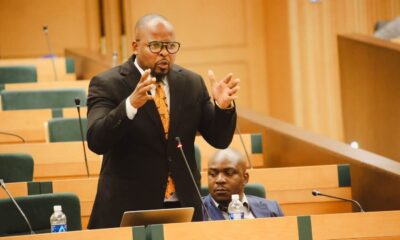
HON. HAMAUSWA: Thank you Madam Speaker. I would like to thank you for this precious opportunity to air views regarding CAB3. On behalf of the good people of Warren Park Constituency, on behalf of all progressive churches, the true Christian community and on behalf of over 10 million people who still…
HON. TOGAREPI: On a point of order Madam Speaker. There are no true and false churches. They are all churches. We are not representatives of churches. You are not a God who knows which one is true and false.
THE TEMPORARY SPEAKER: Hon. Hamauswa, can you please withdraw.
HON. HAMAUSWA: Madam Speaker, I withdraw that
statement, even though the Bible gives us an instruction to test the spirits. It also says there are true and false prophets but for the sake of progress…
THE TEMPORARY SPEAKER: I asked you to withdraw and rephrase your statement, not for you to explain why you are withdrawing.
HON. HAMAUSWA: Madam Speaker Ma’am, I will rephrase. I am also representing all churches and the Christian community.
+HON. MUJEYI: On a point of order Madam Speaker! Hon. Hamauswa does not represent over 10 million people in his constituency.
HON. HAMAUSWA: I know people fear figures. It is fine, I withdraw Madam Speaker Ma’am. I also stand on behalf of all the people of Zimbabwe who hold on to the words of the illustrious son who came to be known as the father of democracy…
*HON. SHONGEDZA: On a point of order Madam Speaker! My point of order states that we cannot proceed if this Hon. Member is lying in this august House. I thank you.
THE TEMPORARY SPEAKER: Hon. Hamauswa, may you be factual.
HON. HAMAUSWA: Madam Speaker Ma’am, I did not even finish my statement. I say to all those in Zimbabwe who believe in the words of one of the illustrious sons of this country, the former Prime Minister, Morgan Tsvangirai, who said that one day Zimbabwe is going to be democratically free.
He actually said he was going to soldier on until Zimbabwe is democratically free. Madam Speaker Ma’am, I thank you and I stand guided by your wisdom. I was saying that I am representing a section of the people of Zimbabwe, who believe to the words of one of the illustrious sons of this country, the late Former Prime Minister Richard Tsvangirai, who vowed that one day Zimbabwe will be democratically free.
In advancing this dream, I stand here to move that this Bill be rejected in total. An Hon. Member having switched off the microphone.
HON. HAMAUSWA: Madam Speaker Ma’am, we have also the capacity to match their capacity to frustrate us. We may also retaliate.
THE TEMPORARY SPEAKER (HON. MAUNGANIDZE) – Hon. Hamauswa, can you please stick to your debate? That is not part of the debate. Can you speak to the presentation that was made by the Hon. Minister?
HON. HAMAUSWA: I was seated here and I never interrupted anyone. This is not their country; we all belong to the same country. This is the reason why we are rejecting this Bill. This is the reason why we say this Bill does not promote equality. The way we are being treated here is pathetic. Is this the Parliament that is going to elect the President? A Parliament without order.
THE TEMPORARY: Order. Hon. Hamauswa, may you stick to your debate?
HON. HAMAUSWA: This is part of the debate, Madam Speaker, Ma’am, where we cry for Zimbabwe. One day, the history of this nation will be written and it will keep a page for the Tenth Parliament.
Every name recorded in this House will be on that page. Our children will read it and their children after them will ask of us one question, Madam Speaker, Ma’am. That history asks everyone who has ever held power in this land, what did they do when it mattered? This is the time when it most mattered to Zimbabwe.
We already know how to answer that question to those who went before us. When we remember, Mbuya Nehanda, we know what she is remembered for. When we say Sekuru Kakuvi, Sekuru Chaminuka, Cde Herbert Chitepo we know, we know what they stood for. Madam Speaker, Ma’am, I stand where I stood to fight for democratic equality in this country.
We all know how in 2017, Generals like S. B. Moyo, Perence Shiri Mugova, put their lives on the line to restore legacy in this country. We remember the late Richard Morgen Tsvangirai as a general for the democratic struggle. They are remembered because in their hour they refused to surrender the right of these people to Government themselves and some of them paid that refusal….
THE TEMPORARY SPEAKER: Order! Order! What is your point of order, Hon. Minister?
THE MINISTER OF JUSTICE, LEGAL AND PARLIAMENTARY AFFAIRS: Madam Speaker, I think we all know the history. We are here to debate the Bill not to speak about Mbuya Nehanda, he must stick to the Bill.
If he has nothing to debate, I think you must rule on that. We are not getting anything out of what he is saying. There is absolutely nothing that will edify what we getfrom what he has said so far. So, if he has nothing to debate, he might as well sit down. He must stick to the content of the Bill so that we progress, rather than telling lies and saying nothing.
THE TEMPORARY SPEAKER: Hon. Hamauswa, we have a list of people who want to debate, so if you do not have anything to say we will ask you to sit down. May you debate on the presentation that was made by the Hon. Minister of Justice, Legal and Parliamentary Affairs.
HON. HAMAUSWA: People are referencing Americans here! I thank I stand guided by your wisdom. I will not stand here to respond to the Hon. Minister, the Hansard will respond on my behalf.
THE TEMPORARY SPEAKER: You cannot respond to the Minister. May you speak to the debate. If you do not have anything to debate, I will ask you to sit down, Hon. Hamauswa. We have other MPs who want to contribute towards this important debate.
HON. HAMAUSWA: Okay, Madam Speaker, I stand guided. This Bill does the following. It takes away the election of the President from the people and gives it to this House. It lengthens the term of office from five years to seven years.
It switches off the very provision for the people who wrote to stop a sitting office holder from extending his own time in power. It removes from our Defence Forces the written duty to uphold this Constitution.
It takes the registration of voters away from an independent commission and hands it to an office of the Government, an office controlled by the Executive. It abolishes the Gender Commission and the National Peace and Reconciliation Commission. It does every one of these things without going back to the people for a referendum to ask their leave. The Constitution is the Supreme law ….
THE MINISTER OF JUSTICE, LEGAL AND PARLIAMENTARY AFFAIRS: On a point of order Madam Speaker Ma’am. This Bill is not abolishing the National Peace and Reconciliation Commission. He must withdraw that statement.
HON. HAMAUSWA: Madam Speaker, I withdraw that. This Bill does not remove the Peace and Reconciliation. I implore the Minister to consider giving it a new life. The Constitution is the supreme law of the land. Section 2(1) of the Constitution states that this Constitution is the supreme law of Zimbabwe and any law,practice, custom and conduct inconsistent with it is invalid to the extent of inconsistency.
In addressing this issue, Professor Lovemore Madhuku in 2010, said that the reason why the Constitution is given this special place in the hierarchy of law is that, in principle, it is considered to be the weight of the people themselves.
This underlines the importance of a referendum. CAB3 is against the principle of constitutional liberty…
HON. TOGAREPI: Madam Speaker, I do not want to instruct you but what I want to find out is whether Prof. Madhuku is a politician or a lawyer, which one is he talking about?
THE TEMPORARY SPEAKER: Hon. Hamauswa, may you clarify?
HON. HAMAUSWA: Madam Speaker Ma’am, the moment I say Prof. Madhuku, I am referring to a lecture room at the university. You can check on his book – that is unnecessary and I do not think the caliber of the Government Chief Whip will continue doing that? CAB3 is against the principle of constitutionalism.
Wallace:2007, notes that constitutionalism is an idea often associated with the political theories of John Locke and the founders of the American Republic that Government should be legally limited in its powers and that its authority depends on observing these limitations.
This means Government is a creature of the Constitution, it is below the Constitution and not above it. John Locke is well-known for advancing his own version of social contract where they say social contract is an escape route from the state of nature and to a civilised society. The state of nature according to John Locke was characterised by unpredictability laws and judicial independence.
Thomas Hobbes stated that the state of nature was characterised by war of every man against every man and life was nasty, short and brutish. This is exactly what was depicted by the Minister to say there was toxitity; I would want to refer it to a situation that is in the state of nature.
I propose that allegations of rigging and characterised electoral cycles in this country, electoral violence was also there as a result of allegations of policy inconsistencies where we have policies like ZIMASSET, indigenisation laws that have been changed midway without being implemented.
So the social contract theorists advise that the route from chaos to a normal civilised State is through dialogue, not nefarious change of governing structures or the use of law to tilt the power matrix as is going to happen in the Senate.
Currently, we know that without the vote from the Opposition, the ruling party will not have a two-thirds majority. It means that if that vote is used wisely, this Bill is not going to pass. Once the Bill is passed, the President is going to have an unfair and authoritarian advantage to control both Houses and this should not be allowed.
If it was going to be suspended, maybe until after an election. So, we cannot have a situation where a sitting President would then change a law that would then tilt the power matrix in the Senate. According to Greg Leamington (2001), constitutions are generally difficult to change and fundamental constitutional principles are placed beyond a simple majority.
THE TEMPORARY SPEAKER: Order Hon. Hamauswa, you are left with five minutes.
HON. HAMAUSWA: This led to the principle called counter majoritarian rule. An American scholar, Stephen Holmes, writing in support of the counter-majoritarian position, states that the basic function of a constitution is to remove certain functions of a constitution from democratic processes that it ties the community’s hands.
This is to withdraw certain subjects from political controllers so as to place them beyond the reach of simple majorities and to establish, for instance, the amendment of the right to vote to elect the President.
Historically, Madam Speaker, Zimbabwean courts have ruled that the Constitution gives them power to determine, in the event of litigation, whether Parliament had acted within the provisions of the Constitution when enacting the law in question.
Courts can set aside and invalidate any legislation enacted by Parliament if the correct procedures were not followed. The Supreme Court explained this position in the case of Smith vs Mutasa and another.
This was in relation to the former Rhodesian Prime Minister, Ian Smith, who, in 1989, the Parliament suspended without salary for making remarks that were considered as contempt of Parliament.
Dumbuchena, C. J. then said the Constitution of Zimbabwe is the supreme law of the land. Parliament is indeed supreme in the legislative field as assigned to it by the Constitution but even Parliament cannot step outside the bounds of the authority prescribed to it by the Constitution.
The learned Chief Justice, according to Leamington, stated that Zimbabwe is a constitutional democracy.It is not a parliamentary democracy. In a constitutional democracy, both Parliament and the Executive are creatures of the Constitution.
Therefore, they can only do what they are prescribed to do by the Constitution. Madam Speaker Ma’am, on the passionate plea for a Referendum, I would like to encourage the Minister of Justice, Legal and Parliamentary Affairs to consider the essential features doctrine. I would like to refer this House to the words of the then Chief Justice Gubbay who considered the application of the essential features doctrine…
THE MINISTER OF JUSTICE, LEGAL AND PARLIAMENTARY AFFAIRS (HON. Z. ZIYAMBI): Madam Speaker, the Hon. Member rightly pointed out that we are supposed to be guided by the Constitution. He must show me where in the Constitution it is written that we are supposed to go for the Referendum. We do not need to be told what a scholar said; he must tell me what the Constitution says and what the Bill is doing that is violating that provision.
THE TEMPORARY SPEAKER: Hon. Hamauswa, do not create your own Constitution and your time is up