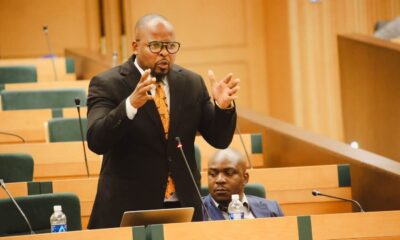
HON. MAMOMBE: Thank you Madam Speaker, for giving me this opportunity to debate the Constitution of Zimbabwe Amendment (No. 3) Bill of 2026. In doing so, I carry with me the views and concerns of the citizens of Harare West Constituency, gathered through a constituency consultative meeting that I held on the 21st of March, 2026, in Marlborough, Harare West Constituency.
I wish to state from the outset that the people I represent expressed overwhelming opposition to this Bill.
They believe it weakens democratic governance, undermines constitutionalism and erodes sovereignty.
Our Constitution is not an ordinary statute. It is the supreme law of the land and a social contract between the citizens and the State.
At the centre of this Bill today is a fundamental question: Does this Bill strengthen the sovereignty of the people or does it take away the power from the people and concentrate it in the Executive?
The Constitution of Zimbabwe is founded on popular sovereignty.
The legislative authority that we enjoy today is derived from the people.
Parliament is therefore not a master of the Constitution but Parliament is a servant of this very Constitution.
Madam Speaker, this Bill, when read as a whole, does not merely make technical changes.
It forms a coherent scheme that weakens electoral accountability, reduces citizens’ participation and consolidates power in the Executive.
When I was going through this Bill as presented by the Hon. Minister Ziyambi Ziyambi, I saw a troubling pattern.
I saw that the Bill seeks to take away the people’s direct right to elect their Head of State.
I saw that the Bill also seeks to extend the term of elected officials.
I also saw that the Bill weakens the independent institutions and concentrates more authority in the executive.
I am, therefore, Madam Speaker, convinced that these amendments move this country, Zimbabwe, in the wrong direction.
Let me go clause by clause. I want to start with Clause 2.
It removes the voter registration, compilation of the voters’ roll and custody of the voters’ roll from an independent Zimbabwe Electoral Commission and transfers those roles and functions to the Registrar General.
As Harare West Constituency, we reject this clause.
The voters’ roll is a foundation of a free and fair election.
Whoever controls the voters’ roll, controls the critical part of our electoral process.
Moving this function from ZEC to the Registrar General weakens electoral independence and places a core electoral function under an office that lacks the same constitutional safeguards as the Zimbabwe Electoral Commission.
Madam Speaker, if the concern with ZEC is efficiency, the answer is very simple.
The answer is not to strip ZEC of its mandate.
The answer is to strengthen ZEC by making sure we improve data sharing with the Registrar General and modernising registration systems.
We are now in the fourth industrial revolution where we can leverage AI to improve processes and ensure transparency within ZEC.
Let me quickly move on to Clause 3. This is one of the most dangerous clauses.
It proposes that the President must be elected by Members of Parliament in a joint sitting of the Senate and the National Assembly.
The people of Harare West are very clear, the President must be elected directly by the people. We maintain that one person, one vote.
Madam Speaker, the question is, are we saying the liberation struggle and its gains were a mistake? One person, one vote, was it a mistake? I want to say today, let us not strip citizens of their right to vote. Why should an elected few decide for the majority?
A direct presidential election is not a democratic feature of our democracy.
This is a central mechanism through which citizens exercise sovereignty.
Removing the people’s direct vote for President reduces millions of Zimbabweans to spectators while a small group of parliamentarians decides who becomes the Head of State.
Madam Speaker, this clause also creates serious risk of patronage, bribery, intimidation and political bargaining.
In a context like our country where money and executive power already influence political processes, reducing the electoral college from millions of citizens to a few parliamentarians is very dangerous.
Even more concerning, the proposed clause appears to allow a person who was never directly elected by the people or even rejected by the voters to become President through this Parliament.
This is not democracy. This is a removal of the people from the centre of government. I, therefore, oppose Clause 3.
Madam Speaker, let me move to Clauses 4, 9 and 10, which talk about the extension of terms from five years to seven years.
In 2023, the President and Members of Parliament were elected for a five-year term. No candidate sought a mandate from the people for seven years.
To extend the term after the election is to alter the people’s mandate after it has already been given.The Bill is about consolidation of political power.
This is what we have seen since this debate started. If one examines the political campaigns surrounding this Bill, particularly the advertisements that have been put out on radio and television, the focus is not on deepening democracy or strengthening our institutions or even improving governance.
The focus has been on an individual. If you listen to the jingles, if you listen to the songs around this Bill, they have been centred on an individual and we reject this Bill.
No elected body has the moral or constitutional authority to unilaterally extend its own term of office without returning to the people.
This is precisely why Section 328 (7) exists. It improves the incumbents. It prevents the incumbents from benefiting from the amendments that extend their term in office.
It is a constitutional firewall against self-serving amendments.
If leaders want a seven-year term, they must ask the people directly through a referendum and apply these changes only for future officeholders, not this current Parliament.
Clause 8 allows the President to appoint additional senators.
The proposal de-democratises the Senate. Senators must represent the people and their provinces, not Presidential preference.
The danger, Madam Speaker Ma’am, becomes clearer when Clause 8 is read together with Clause 3.
If Parliament elects the President and the President appoints the Senators, then the system risks being secular.
There is Presidential influence shaping the body that may intend to choose the President in the future.
This also affects the constitutional amendment arithmetic. Additional appointed Senators, as proposed by the Bill, can alter the balance of power in Parliament and make it easier for a ruling party to reach a supermajority without securing a genuine two-thirds mandate from voters.
This is not a technical reform. It is a constitutional fraud. Let me move to Clauses 11, 12, 13 and 17.
These clauses talk about the electoral Delimitation Commission and the reduction of the ZEC function.
The delimitation and voter registration must remain with ZEC and ZEC must be strengthened.
The problem with our electoral system is not that ZEC has too much independence. The problem is that citizens, want more transparency, want more independence, more accountability and more public confidence.
The proposed Delimitation Commission would be appointed by the President. Again, this is an executive override.
That creates a risk that boundary delimitation, one of the most politically sensitive electoral functions, may become a subject of executive influence.
Free and fair elections require an independent institution. These clauses move us in a different direction.
The repeal of the constitutional provision requiring traditional leaders not to be members of political parties or to participate in partisan politics, this is Clause 21. We strongly reject this Clause.
Traditional leaders serve communities made up of citizens with different political views.
Their authority depends on neutrality, fairness and trust.
If traditional leaders become openly partisan, their constitutional role as community leaders and quasi-judicial authority is compromised.
This clause also affects the Senate because the chiefs are going to be sitting in the Senate as Members of Parliament.
Therefore, if chiefs are no longer constitutionally required to be non-partisan, then the democratic legitimacy of the Senate is further weakened. You have an additional 10 senators; you have chiefs who are now partisan.
This will weaken our Senate.
The traditional leaders must remain above partisan politics. They must not subscribe to any political party.
The recurring message from the constituency that I represent in this august House, Harare West Constituency, was to demand a referendum.
The people of this country made the Constitution. The people must decide whether it must be fundamentally altered. As their representative today, I wish to place their views before this House and submit that the Constitution of Zimbabwe, Amendment (No. 3) Bill, must be rejected in its entirety.
The Constitution must be rejected in its entirety. The Constitution of this country belongs to the people and no one has the right to play around with the people’s Constitution.
I therefore submit the views and concerns of the people of Harare West Constituency. I thank you.