
News
Hopley pleads for a High School
A tragic accident unfolded around 6:30 pm near the Trabablas Interchange when a young boy was struck dead on the morning of 29 August 2025 by a commuter omnibus just 100 metres from the junction.

A tragic accident unfolded around 6:30 pm near the Trabablas Interchange when a young boy was struck dead on the morning of 29 August 2025 by a commuter omnibus just 100 metres from the junction.
This is the fear of every mother in Hopley with a child who is going to school in neighbouring locations of GlenNorah and Waterfalls, because Hopley only has one council primary school, Tariro Primary School and no Secondary School.
Tariro Primary School was built by City of Harare in partnership with Mashambanzou Trust in 2019, and no government-run secondary school is yet to be constructed in the area- six years on.
“We have lost many children at the Trabablas Interchange and even before when it was still Mbudzi Round about as they go to school or come back from school in GlenNorah,” said Chairperson of Hopley Parents Teachers Association, Yvonne Bosha.
“There is hot seating in these institutions because of the numbers of children enrolled there.”
Bosha adds that the situation is dire.
Private Schools are there in Hopley but are not within reach for majority of the impoverished parents.
“We have private run schools here which charge from USD$20 to USD$30 pee month and it is not within our reach. So our children have to cross Trabablas Interchange and even before Trabablas, they crosses the Mbudzi Roundabout, to access government run secondary schools in GlenNorah and Waterfalls,” said Bosha.
Action Aid’s policy brief titled Prioritizing establishment of a public secondary school in Hopley reveals that besides unaffordable costs, the institutions are resourced by underqualified personnel.
“While private schools exist, they are expensive, inadequately equipped, and staffed by underqualified teachers. Consequently, children either travel long distances to neighboring suburbs for education or remain idle, exposing them to social ills,” reads the brief.
Hopley, a peri-urban settlement located 17 km south of Harare, is home to over 200,000 people, with approximately 3,000 school-aged children.
Despite such numbers, Hopley residents are clutching at straws to enable their school going children to access education.
Section 19.2(d) of the constitution of Zimbabwe states that : The state must adopt reasonable policies and measures within the limits of the resources available to it, to ensure that children have access to education and training.
The Ministry of Local Government Layout Design Manual, says for every 500 to 700 residential units, there should be a primary school and for every 3 to 5 feeder primary schools there should be a secondary school, but this is just theory for the people of Hopley.
Bosha says they plan to petition parliament to have the Constituency Development Fund channeled towards building a school for the people of Hopley.
“Plans are afoot to go to parliament and petition them to prioritise Constituency Development Fund to be directed towards
She adds that they are going to approach City of Harare to allocate them land to build a Secondary School.
“We are going to see the Mayor, so that land that was meant for a school be put to its use,” she said.
The issue of land in irregular settlements such as Hopley is contentious, land meant for sporting facilities clinics or schools are quickly built up by land seeking people with the help of land barons.
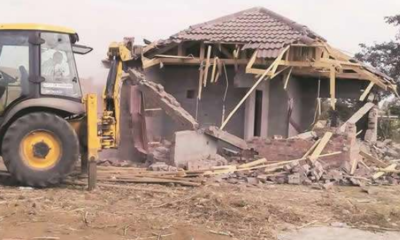
In Budiriro, land that was meant for a sporting facility was invaded by land barons and it took the Member of Parliament, for Budiriro South to personally take the matter to City of Harare, and the invaders were evicted and their structures demolished.
Auditor General’s Value for Money Report on Facilitation, Provision and Construction of Schools by Ministry of Primary and Secondary Education tabled before Parliament in January 2025 notes the issue of delayed construction of schools as a reason for land barons to take up space meant for critical facilities such as schools.
“I noted that public schools were not being constructed in new settlements despite the settlements having large numbers of families living in the areas. Out of the forty four (44) sites reserved for the construction of schools for the period 2003 to 2015 only one (1) was developed, two (2) were partially developed and forty one (41) were not developed. The consolidated information for the period 2018 to 2023 on the reserved sites for the whole country was not availed by the Head Office for audit inspection. Due to delays by the Ministry to construct schools in reserved sites, the sites were being occupied by illegal settlers. Houses were being constructed in some sites and some sites were being turned into agricultural land,” reported Auditor General Reah Kujinga.
She added that government had failed to meet its target of building 1800 schools over six years (2018 to 2023), translating to 300 schools a year despite disbursing over ZWL$ 4 billion towards construction of schools.

“Schools were not being constructed as per the plan. The plan was to construct three hundred (300) schools per year translating to 1 800 schools for the 6 years under review, 2018 to 2023. However, only two hundred and forty-two (242) were constructed during the period under review. Delays to execute the construction plans resulted in overcrowding in schools. As a temporary measure the Ministry was using satellite schools and hot seating sessions which were not conducive for learners,” she added.