BY NATHAN GUMA, recently in New York
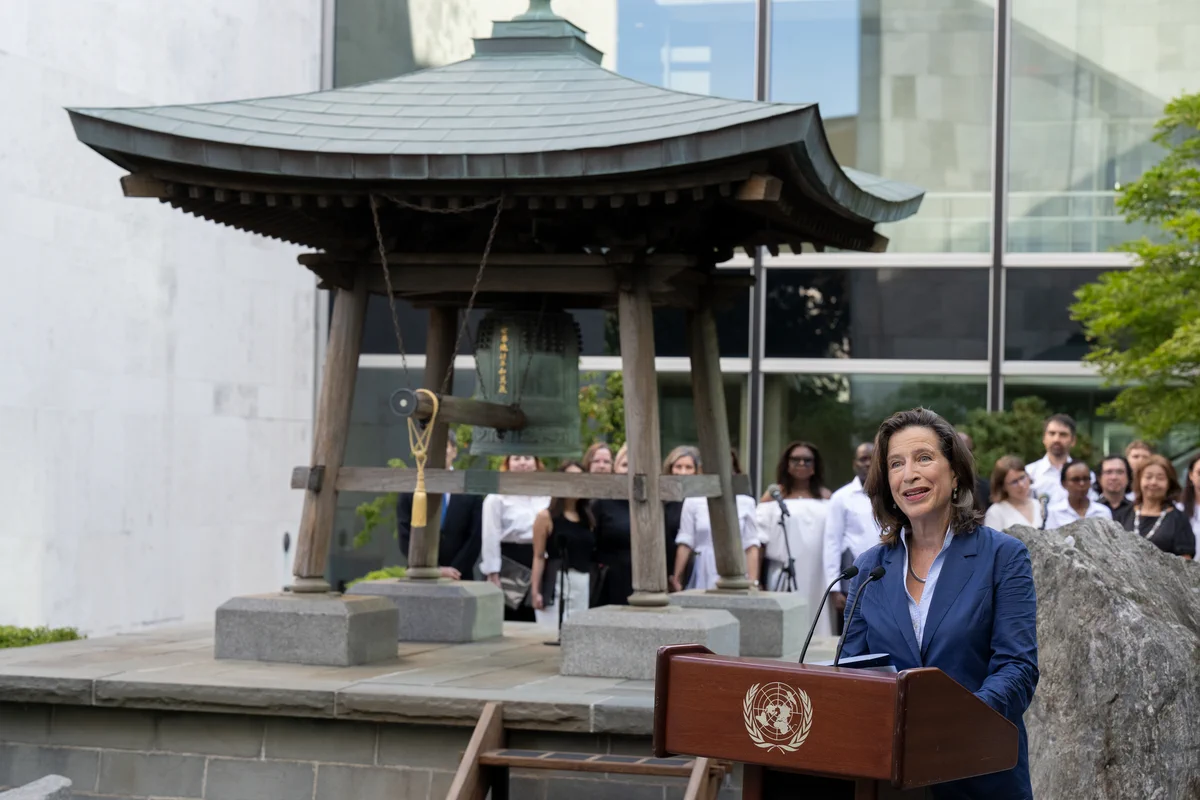
NEW YORK – THE United Nations has rung its Peace Bell to commemorate the International Day of Peace, but Secretary-General António Guterres warned that global efforts to build peace are faltering as conflicts widen and deepen, calling on world leaders to invest in diplomacy and dialogue.
This also comes at a time when international conflict has been increasing worldwide.
The Japanese Peace Bell, symbolising peace, was cast from coins donated by delegates from 60 nations in 1951 and presented to the UN in 1954 by the UN Association of Japan.
It is traditionally rung twice a year, first on the first day of spring at the vernal equinox, in celebration of the annual Earth Day and on every opening day of the General Assembly in September to commemorate International Day of Peace.
Speaking during the ceremony, UN secretary-general Antonio Guteres said world peace has been waning, amid an increase in conflicts, hence the need for peace.
“Conflicts are widening and deepening,” he said. “People are suffering. And the dialogue and solidarity that solutions require are missing in action.
“But where governments are failing to deliver peace, people around the world, volunteers, advocates, civil society, leaders, peacekeepers and peacemakers are doing the heavy lifting of peace, raising their voices, bridging divides, healing communities.”
He urged international leaders to investing in sustainable development, which includes health, education, nutrition and social protection.
Newly-elected president of the 81st General Assembly, Khalilur Rahman said the bell ringing is a reminder to build on peace.
“It’s not easy, but this is a difficult task that we must do,” he said. “Indeed, to invest in peace is to invest in trust, and 81 years on, in the confidence that multilateral actions can still deliver for those it exists to serve.
“Like the peace bell, the UN was formed in a crucible. From the ashes of war, it ushered in a new dawn, bringing countries of different histories and cultures together to build something greater than any could build alone.”
What the data says
Data by the Global Peace Index by the Institute of Economics and Peace (IEP) shows global peace deteriorated by 0.7% over the past year.
Countries recording lower scores in 2026, generally improved their levels of peacefulness, while increases in scores indicated deterioration compared with the previous year.
Some of the largest improvements were recorded by Türkiye, Ukraine, Uzbekistan, Equatorial Guinea and Honduras, which registered notable declines in their scores between the two years.
However, several countries recorded higher scores, including Argentina, Australia, China, India and Tanzania, indicating worsening peacefulness during the period under review.
Conflict-ridden Russia recorded the highest 2026 score at 3.367, followed by Sudan at 3.195 and the Democratic Republic of the Congo at 3.189.
At the other end of the scale, Iceland remained the most peaceful country in the dataset, with a 2026 score of 1.161, followed by New Zealand at 1.343.
Zimbabwe recorded a score of 2.051 in 2026, down from 2.223 in 2025, representing an improvement in its peacefulness.
The data also shows that while deaths from internal conflict deteriorated 7.1% alongside rising militarisation and domestic unrest, UN peacekeeping funding improved -5.9%, reflecting reduced external conflicts and terrorism impact.
Overall, the data shows that changes in peacefulness were uneven across countries, reflecting differing movements in their GPI scores.