BY NATHAN GUMA
THE European Union Delegation in Zimbabwe says the country’s debt arrears remain a major obstacle to financing renewable energy projects, despite growing international support for the sector.
Zimbabwe’s total public and publicly guaranteed (PPG) debt has been increasing, reaching US$23.4 billion by September 2025, with over US$7.4 billion in external arrears.
The country’s debt-to-GDP ratio was estimated at around 87% in late 2024, causing severe distress and limiting access to international financing.
The EU in Zimbabwe has supported renewable energy initiatives, including the rehabilitation of Lake Kariba, the country’s largest hydroelectric power source.
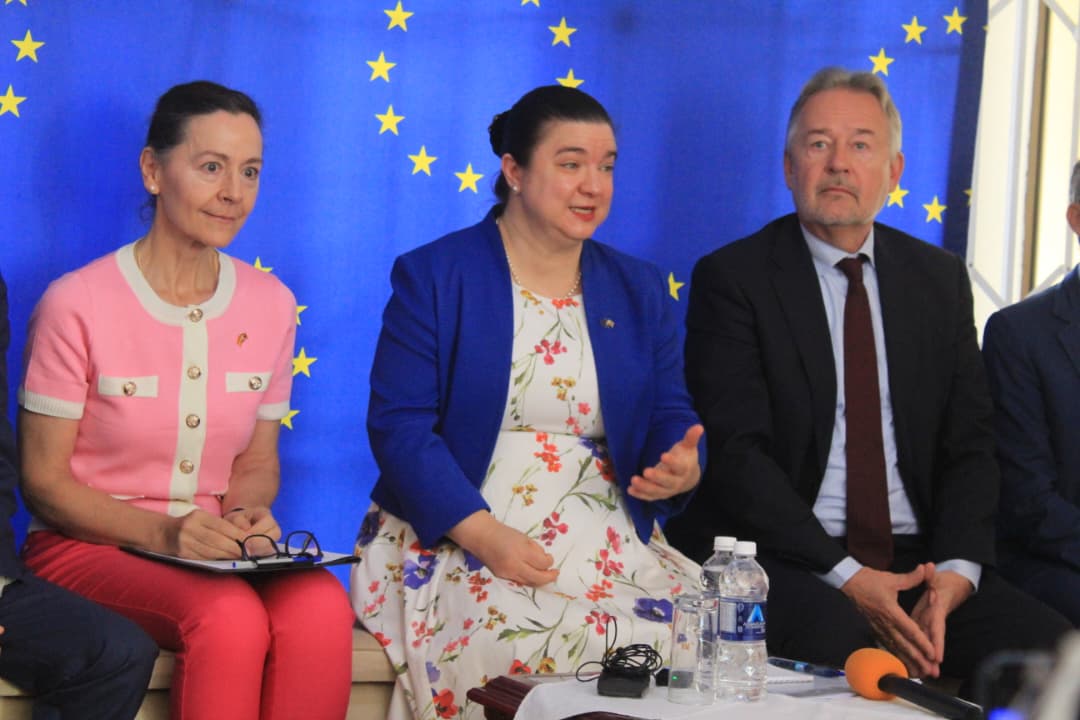
“This has been part of a cross border project together with a delegation in Zambia, since it is a cross-border project,” said Katrin Hagemann, EU Ambassador to Zimbabwe while responding to a question by The NewsHawks on the bloc’s stance on climate change and access to renewable energy.
“More generally, the European Union is very strong on supporting all kinds of renewable energies in Africa. We very much see the future there and we are also concerned about the effects of climate change and therefore want to support Africa in directly sort of jumping to renewable energies and being strong there.”
Ambassador Hagemann said that the country has so much potential in transitioning to renewable energy through use of sources such as solar, wind and water among others.
“As we look forward, there’s more on, let’s say, resilience building in rural areas, where we’re looking at solar off-grid support to support areas that don’t have access to the grid. So those are the areas that we’re currently focusing on,” she said.
Arrears clearance
She said that while financial institutions such as the European Investment Bank have interest in projects around access to renewable energy, there is need for debt clearance.
“But indeed, we are also looking at how sort of projects could be addressed in the future. I think that also our bank, the European Investment Bank, is very interested in that part,” she said.
“For that, I have to stress it’s important that the government continues along its path of clearing the areas, because some of the things are just not possible as long as the areas aren’t cleared.”
“So in that context, we’re really welcoming the signing of the S&P and hoping that we now have a path forward with the S&P and then the clearing of the areas, which will really open up much more in terms of lending, blending, guarantees of banks in order to invest in this country.”
In response to The NewsHawks, French Ambassador to Zimbabwe, Ambassador Paul-Bertrand Barets said that while there is potential for more projects around access to renewable energy, most of them are likely to be hampered by the debt clearance process.
“Look at the Kariba Dam that you mentioned. It was built initially by Italian and French companies, building companies, in the 60s or 70s, I think,” he said.
“And now it is being rehabilitated with our support and with, by the way, by a French company that is doing the job and that has achieved it recently, after five years of work.”
He said that while they have set up a French-Zimbabwe working group on green finance, to supplement government funded green-initiatives, their efforts can be limited by the debt clearance process as European companies may get little support from financial institutions due to Zimbabwe’s huge debt overhang.
“The challenge is so huge that you have to mobilise the private sector, philanthropies, private companies, private investors,” he said. “So the very purpose of this French-Zimbabwe working group that has met already two times is to catalyse private sector, private investment towards the conservation of biodiversity.
“But as said very rightly by the ambassador to the EU, we won’t, we will be limited at some stage if we collectively are not able to sort out, solve the debt areas problem that is really limiting for now, the capacities, the possibilities for the international financial institutions to intervene in Zimbabwe.”
He said while the French company working on the Kariba rehabilitation project has a lot of projects in Zimbabwe, potentially in terms of rehabilitation, building of dams, it is limited by the fact that there is no international financial partner that is ready to co-finance for now.
“So that’s really the very meaning and purpose of our contribution to the high-level dialogue on debt areas that has been set up by the president and where we are very active to find solutions for this very crucial problem.”