STAFF REPORTER
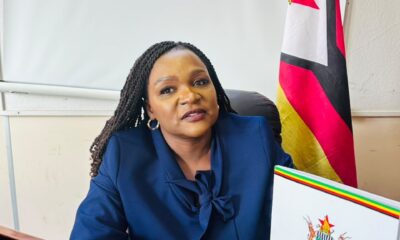
ATTORNEY-General Virginia Mabiza has dismissed claims of widespread oppositioon to Constitutional Amendment Act No. 3 (CAA3), saying the narrative is being driven by a small group of recurring litigants rather than reflecting the views of the broader public.
Speaking to the media, Mabiza said the legal challenges being cited as evidence of mass resistance were limited in scope and largely repetitive.
“Claims suggesting widespread opposition to Constitutional Amendment (Act6/ 2026) popularly referred to as CAA3 are misleading and do not reflect the correct position on the ground,” she said.
Recently, a group of individuals calling themselves war veterans have been taking turns to file court applications against the Government over the enactment of the constitutional amendments.
Mabiza dismissed suggestions that the volume of cases indicated growing resistance to the amendment.
“We are not overwhelmed by these cases, nor do they represent a surge in public opposition.
“In simple terms, the level of public outcry being suggested is far greater than the actual numbers involved. The narrative of extensive opposition is amplified beyond the facts and should not be mistaken for the true scale of engagement with CAA3.”
Her remarks come after she urged the country’s apex court to strike off a legal challenge by war veterans against CAA3.
In her response to a recent application by six former freedom fighters seeking direct access to the Constitutional Court (ConCourt) following the enactment of CAA3, Mabiza said the applicants had failed to demonstrate how their rights were violated by the new law.
“Prior to relating to the merits or demerits of the matter, I wish to make preliminary observations whose effect is to render the application susceptible to summary striking off or dismissal.
“I am advised, which advice I accept, that an applicant in an application for direct access must plead with specificity to not only acquaint the respondents with the case it makes or seeks to make — but to also attune the court and all stakeholders to the particular Act, section or misconduct on which relief is sought.
“I have perused the form and the application, and have failed to locate the particular sections of Constitution of Zimbabwe (Amendment) (Number 3), ACT of 2026 which are being impugned,” Mabiza said.
“This is further compounded by the following facts that the Act itself is not an attachment to the application.
“That the Act is not being challenged as a whole; and that the Act has 29 sections with different proviso and sub provisos.
“Even the intended Section 85 application does not particularise the exact provisions of Constitution Amendment Number 3 Act of 2026 which are sought to be impugned, related to or ought to be pronounced upon.
“Considering that constitutional litigation is exact, precise and particularised litigation, the obligation to plead and cite with specificity is mandatory and indispensable.
“The applicants have left it to the court and the respondents to peruse the ACT and seek through conjecture, speculation, and surmise which provision best meets the applicants case.
“This, I am advised, renders the application inchoate and fatally defective in breach of rule 22 and authorities of this court,” Mabiza argued further.
“In addition to the above, the applicants have not identified with exactitude, the rights, basis or aspect of locus which brings them to court.
“They have adopted the entirety of the section and seek to rely on globular inexact standing.
“I am advised that this is incompatible with the practice of this court,” Mabiza also said.
She further argued that the applicants had failed to identify the exact provisions of the amendment they considered unconstitutional and that their claims that CAA3 curtailed political rights were without merit.
“I note that in these constitutive paragraphs, the applicants still deliberately fail to make mention of the exact sections or provisions of Constitution Amendment Act Number 3 of 2026 which are deemed incongruent.
“They make generalised averments and leave all and sundry unaware of the case they seek to make juxtaposed against the actual text of the impugned Act.
“Aside from this failure, it is denied that any political rights or choices are abrogated. The applicants have never enjoyed blanket rights to elect any individual.
“Applicants and all members of the public have always been elected from a pool of candidates imposed by registration or chosen by political parties. As such no right is available for vindication.
“In the same vein, the Constitution has always recognised representative decision making in all aspects of governance, from the legislative, judiciary and executive.
“The source of all authority remains the people, notwithstanding the exercise of that authority in delegated circumstances,” Mabiza added.
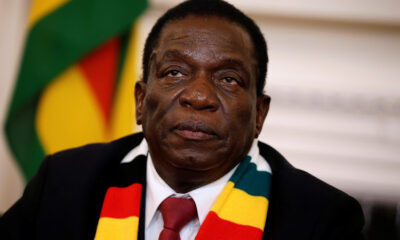
She also objected to the inclusion of President Emmerson Mnangagwa as a respondent.
“I take the point to be advanced in argument that the citation of the President in these proceedings, in circumstances where no relief is sought against him, no allegations are made against him, and no constitutional delinquency attributed to him is improper.
“Further take the point that the above citation, arising solely from an exercise of constitutional prerogative, is not challengeable nor reviewable under the above circumstances.
“It is further not contestable as it constitutes an act of deliberate judgment and exercise of executive power,” Mabiza said further.