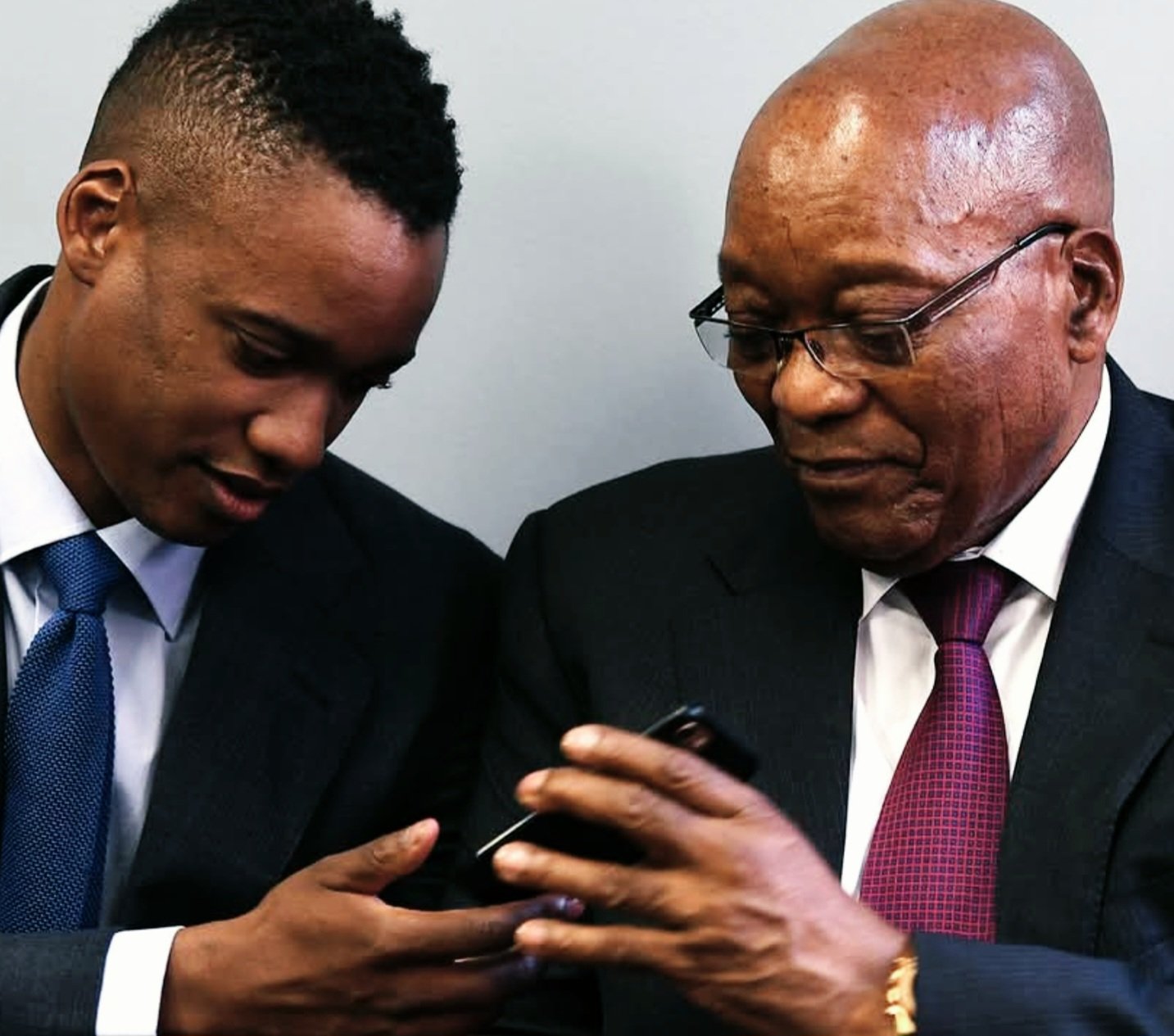
In a move which undermines internal institutional democracy and confirms that South Africa’s opposition uMkhonto weSizwe Party (MKP) is run like a family enterprise – Stokvel – or spaza shop, party leader Jacob Zuma removed his deputy Justice John Hlophe and replaced him with his favourite son Duduzane who has no political credibility, capacity or experience ahead of critical local government elections in November.
In the process, Zuma took over political oversight of the party, including its secretariat, all key functions and finances, making it virtually a family business.
Duduzane Zuma was reportedly appointed because he is the key fund-raiser of the party, hence Zuma wants the money to be kept under family control and custody.
This comes amid a series of political purges and instability within MK in recent months.
MK has removed, suspended, or reshuffled several high-ranking officials amid internal leadership changes, including Hlophe, Nkosinathi Nhleko, Nomsa Dlamini, Nhlamulo Ndlela, Duduzile Zuma, Floyd Shivambu, Mpiyakhe Limba, Colleen Makhubele, and Jabulani Khumalo, among others.
The father-led, family-deputised structure of the MK Party, which is rare even in Africa where corruption and patronage thrive, has damaged the reputation of the organisation in which Zuma controls everything: Power, policy, money, positions and patronage.
MK has no sound institutional, ideological and policy foundation; it is based and relies on Zuma’s personality cult, ethnic and regional vote and populism.
The MK does not operate on a traditional ideological and policy manifesto; it operates on the cult of personality surrounding Zuma.
Deploying his son as a key deputy ensures the seamless continuity of his personal brand.
It signals to the electorate that voting for the party is an act of loyalty to Zuma, effectively turning the party, a public entity, into a private family franchise.
MK has upended South African politics, transforming from a nascent breakaway faction into a formidable political force.
At the heart of its meteoric rise and controversial internal governance is a distinct dynastic structure: leadership anchored firmly by a father as the supreme leader and his offspring occupying pivotal deputy leader’s like in some dictatorships around Africa, for example Equatorial Guinea where Teodoro Obiang Nguema Mbasogo is the President, and the vice-president is his son, Teodoro Nguema Obiang Mangue.