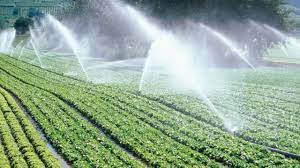
The Government has announced plans to dramatically expand irrigation infrastructure by 2030 in a bid to enhance food security, increase agricultural output and strengthen Zimbabwe’s resilience to climate change.
Speaking on the country’s irrigation development programme, Minister of Agriculture, Mechanisation and Water Resources Development Anxious Masuka said irrigation remains a key pillar of Government’s strategy to transform the agricultural sector through sustained investment in state-owned and community irrigation projects.
Masuka said the Agricultural and Rural Development Authority (ARDA) aims to increase irrigated land across its estates from 2,500 hectares cultivated during the last farming season to 25,000 hectares by 2030.
‘This past season, 2,500 hectares was put on ARDA estates, the 24 or so estates, and we hope that by 2030 they will be able to do 25,000 hectares all irrigated,” he said.
The minister also revealed that Zimbabwe has 460 irrigation schemes covering approximately 26,000 hectares, of which 341 are currently operational.
He said the schemes have been reorganised into business units under the Vision 2030 Accelerator Model to improve efficiency, productivity and accountability.
According to Masuka, the operational irrigation schemes are producing crops on between 13,000 and 19,000 hectares under contractual arrangements, with harvested grain being delivered to the Grain Marketing Board (GMB).He added that Government is extending irrigation support beyond ARDA estates through joint venture partnerships involving communal, A1 and A2 farmers to broaden agricultural production.
“But ARDA also goes further and contracts directly with farmers, communal A1 and A2, under a joint venture framework. So this delivery, although denoted ARDA, represents many sectors and many farmers,” he said.
Government believes the expansion of irrigation infrastructure is essential for cushioning agriculture against erratic rainfall and the growing effects of climate change while enabling year-round production.T
The Ministry of Agriculture says increased grain deliveries are strengthening the Strategic Grain Reserve, improving national food security, reducing reliance on imports, supporting rural livelihoods and ensuring a consistent supply of grain to millers and industry.
The irrigation expansion programme is part of the National Development Strategy 2 (NDS2), which seeks to build a productive, climate-resilient and food-secure agricultural sector in line with Zimbabwe’s Vision 2030.