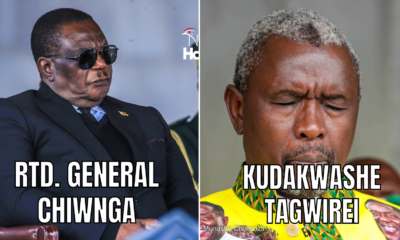
Details of Vice-President Constantino Chiwenga’s damning accusations against several local business moguls, including multi-millionaire tycoon Kudakwashe Tagwirei, of looting US$3.2 billion from state coffers, including 45% of Sakunda Holdings that he says belongs to the ruling Zanu PF, are now fully out in the public domain.
These are contained in his confidential document to the ruling party’s top leadership and the politburo presented to President Emmerson Mnangagwa on September 17.
In his secret document to Mnangagwa and senior party officials and the politburo, Chiwenga says Tagwirei and others “stole” US$3.2 billion from public resources and they should be arrested immediately.
He goes on to say how 45% of Sakunda belongs to Zanu PF, lamenting that the party was not receiving any dividends or profits, but donations of their money from Tagwirei.
Chiwenga said: “Comrade President, these criminals and their associates (Tagwirei, Wicknell Chivayo and Pedzisayi “Scott” Sakupwanya and others) have been engaged in a brazen and systematic campaign and stealing from our government and to date, they have stolen more than US$3.2 billion of government funds.”
He said public funds were looted through various payments: US$1.9 billion; US$800 million; US$238 million; and US$222 million. Telling Mnangagwa, Chiwenga said:
“Tingarambe takatarisa vanhu vachiba more than US$3.2 billion in cash from our state coffers while our people are suffering out there? Even mealie meal is now running out because of maize shortages while we are prioritising paying these criminals, ma hospitals are running out of critical medicines and now the same people who are stealing our assets and resources are now using these resources to hijack power, corrupt our structures and destroy our party?
“Comrade President, the time for silence and inaction is over, and we cannot allow these criminals who have stolen from our government coffers and our party to start using the same resources to bribe fellow comrades and our structures to get their support, defend and protect them.”
Chiwenga added: “These criminals are not just enriching themselves; they are using their stolen wealth to capture our party, manipulate state institutions, and compromise key officials. They are creating a parallel power structure funded by the very state they are destroying. This cannot be tolerated for a single day longer.”
In the process, Chiwenga also accuses Tagwirei of “stealing” and “concealing” Zanu PF’s 45% shareholding in Sakunda Holdings held by Mvuto Investments (Private) Limited, an investment vehicle of the ruling party controlled through the National Reconstruction Group – never publicly acknowledged before – which was purchased in November 2013.
Checks show that the National Reconstruction Group was used to hide a secret stake held by Zanu PF in Kusena Diamonds, which was partly owned by the Central Intelligence Organisation, at the height of the Chiadzwa diamond mining rush.
Zanu PF initially had many companies which were destroyed through gross corruption and incompetence mostly under Mnangagwa’s watch as party secretary for treasury.
An internal 2004 investigation by a Zanu PF five-member committee chaired by the late David Karimanzira showed how the companies were mismanaged and looted.
Sakunda was initially into energy, mining, agriculture finance and construction. Its portfolio has now changed due to shareholding shifts, restructuring and disposals.
The public narrative is that Tagwirei is the founder and co-owner of Sakunda Holdings, with his wife, Sandra Mpunga.
He has said publicly that he sold his house in Westgate in Harare to start his business.
Furthermore, he has opined he sold his house for more than US$20 000 in 2001, just months after starting the company with an initial investment seed capital of US$7 500.
The proceeds from the house sale were used to buy two tankers of fuel, which helped kickstart the business.
Tagwirei says his move paid off, with Sakunda eventually growing into one of Zimbabwe’s largest companies.
Since its establishment, the Zimbabwean conglomerate has grown into a major corporate giant, though its history is marked by controversy and accusations of using political connections and patronage to secure lucrative government deals.
Tagwirei founded Sakunda in 2001, growing it from a small fuel distributor to a major player in Zimbabwe’s energy sector.
A business alliance with Swiss commodities giant Trafigura Group in 2011 gave Sakunda preferential access to the critical Beira oil pipeline from Mozambique, making big money in the process.
Sakunda at one time secured a near-monopoly on Zimbabwe’s fuel imports, accounting for a major fuel supply share of the local market.
It was however controversially stopped from the fuel business later for political reasons.
Mnangagwa’s economic advisor Eddie Cross has claimed that he was behind the removal of Sakunda from fuel business due to shortages and subsequent street protests which happened in 2019, nearly triggering another military coup after the November 2017 putsch.
That year, Trafigura announced it had bought Sakunda’s 51% share of their joint energy venture, seemingly to distance itself from Tagwirei who was about to be put on United States targeted sanctions.
Although many politicians have been removed from American and British sanctions, Tagwirei still remains on the lists.
He is the only Zimbabwean on the UK sanctions list now. Investigations by organisations like Open Secrets and The Sentry say Tagwirei used Sotic International conceal his ownership of Zimbabwean mining assets and move millions of dollars in illicit financial flows.
Following the imposition of sanctions on him in 2020, Tagwirei began restructuring his sprawling business empire. His vast mining interests were moved from Sotic and its subsidiary Landela Mining Ventures into a new holding, Kuvimba Mining House, which was majority state-owned before being bought by government outright.
The Mauritian company that administered Sotic, Capital Horizons, said it terminated its relationship with Sotic and its shareholders after Tagwirei was placed on the US sanctions list in August 2020.
Analysts say Tagwirei’s labyrinth of corporate structures were meant to obscure his continued involvement in different business arrangements through shell companies and fronts.
Tagwirei hardly comments on media stories except on a few rare occasions.
However, he has preached on how he made his money on his regular religious sermons posted on social media.