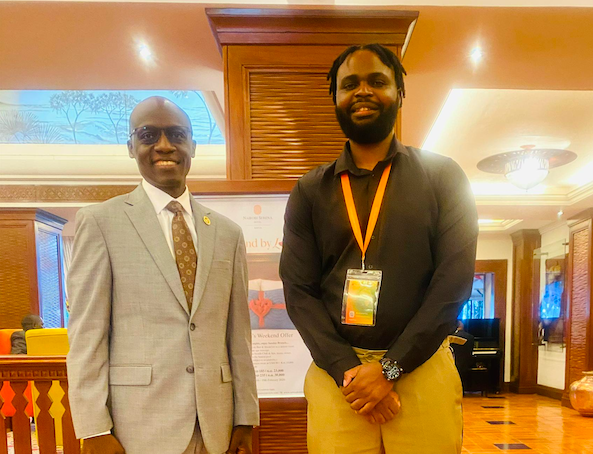
BY NATHAN GUMA
WHEN Justice Mukaro, a Harare-based techpreneur, started his first startup, iSearch,
aimed at the trade of stolen smartphones in Africa, he hoped it would be a massive
idea that would improve the continent’s technological landscape.
This was to be done through an AI-based tracking platform, tracking both the phone
and the people who would have seen it in attempts to make purchases in the
informal market.
However, the idea died a natural death despite its potential.
“The biggest challenge we encountered was the scarcity of crime-related data we
could use to train our systems,” Mukaro says.
However, lessons he learnt from his first start-up have seen him found Strateji.io,
an initiative that is building Afrocentric datasets and the continent’s first data
lakehouse, which is set to improve the SADC region’s data sovereignty.
A data lakehouse is a unified system that stores raw and structured data together,
enabling analysis, governance, and AI use in one platform.
Mukaro says the idea came in 2023 after the public launch of ChatGPT, OpenAI’s
artificial intelligence model, which heavily hallucinated when prompted on African
issues.
“It was competent when you ask it about questions to do with the West and the
Northern Hemisphere. But, it was hallucinating on most things to do with African
languages, cultures and even stock markets,” he says.
“DeepSeek came in from China and it was basically facing the same challenges. So,
we chose to build a data ecosystem that connects Africa to the global AI demand and
it’s not just a technical issue but also strategic, structural and diplomatic.”
How the data lakehouse operates
Mukaro says Strateji’s data lakehouse, the Amanzi Lakehouse, is a dataset
marketplace connecting data-rich African institutions to the global AI ecosystem.
By design, it serves to protect data sovereignty such that datasets from a specific
African country are stored in servers (nodes) that are physically within that country
and are not shared out of that jurisdiction without prior authorisation from the
owners.
“The platform promotes data sharing across the continent, and high transparency is
required, thus we incorporate blockchain technologies for public audits and trails of
every transaction that happens within our ecosystem,” he says.
“Lastly, we exist to make sure that all data providers are paid for the value of their data
that they provide, which is of significant importance as we strive to grow our digital
economies.”
He says this helps the region operate as a unified digital ecosystem without giving up
control over its data, security, and interests, while also enabling it to contribute to
the global AI ecosystem rather than remaining only for consumers.
Diplomatic approach
His work has been driving conversations around data and AI sovereignty in the SADC
region, with him being invited to Uganda and other countries for strategic
partnerships.
This year, he was invited as a guest of the Science, Technology and Innovation
Secretariat under the Office of the President of Uganda, facilitated by Uganda’s
Minister of Science, Technology and Innovation, Monica Musenero Masanza.
“This was a benchmarking exercise for us as Strateji to share about our mission and
the upcoming AmanziCloud pilot project,” he says. “ We were well received and
instantly introduced to local partners, public announcements of the partnerships will
be shared in due course, it was a fruitful trip.”
Mukaro says they have managed to raise awareness on the importance of
Afrocentric datasets for AI, data sovereignty, and the need for collaboration across
various platforms in the Southern African region.
“Most of the region is now conscious to this and they are actively developing policies
to maintain safety in the age of digital intelligence,” he says.
“Policy alone is not adequate and in comes our duty as the private sector to develop
and implement solutions that help enforce the policy and also disrupt it where
necessary so that we rebuild stronger.”
Some of the platforms include the BRICS Youth Innovation Summit, where he was
one of the winning innovators from the region in 2024.
“As part of the winning innovators, I travelled to the St Petersburg International
Economic Forum in Russia and a month later I was back in South Africa as a guest
speaker at the Nelson Mandela University Innovation Indaba.”
From these platforms, he has been getting more opportunities to partner with
additional SADC countries.
“East Africa has been equally welcoming having been received by diplomats during
my visits to Ethiopia, Tanzania, Kenya and Uganda,” he says.
From these engagements, Mukaro says the conversation is increasingly moving
beyond technology into regional coordination, where governments, institutions, and
private actors are gradually aligning on how data is governed, shared, and protected
across borders.
He says artificial intelligence is now increasingly intersecting with digital diplomacy,
as decisions around data infrastructure and ownership begin to influence how
countries position themselves within the global digital economy.
“The real question is not whether Africa can participate in AI, but whether it can do
so on its own terms, with its own infrastructure and value systems embedded in the
process,” he says.