News
𝐓𝐡𝐞 𝐌𝐲𝐭𝐡 𝐨𝐟 𝐭𝐡𝐞 𝐈𝐧𝐟𝐚𝐥𝐥𝐢𝐛𝐥𝐞 𝐋𝐞𝐚𝐝𝐞𝐫: 𝐓𝐡𝐞 𝐂𝐚𝐬𝐞 𝐨𝐟 𝐌𝐮𝐠𝐚𝐛𝐞, 𝐌𝐧𝐚𝐧𝐠𝐚𝐠𝐰𝐚 𝐚𝐧𝐝 𝐂𝐡𝐚𝐦𝐢𝐬𝐚
When a leader is treated as beyond reproach, a cult of personality often replaces accountability and breeds dictatorship.

The idea that certain politicians in Zimbabwe, who are steeped into personality cult politics, are infallible and thus immune from criticism is inherently absurd.
It antithetical to the principles democracy, which underlines accountability, transparency, and free exchange of ideas to hold power in check.
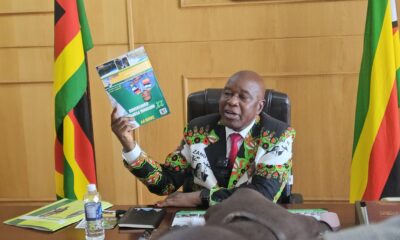
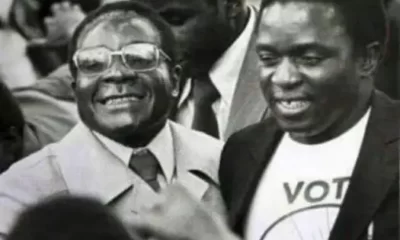
Treating political leaders with Papal infallibility gave Zimbabwe the late former president Robert Mugabe and now President Emmerson Mnangagwa.
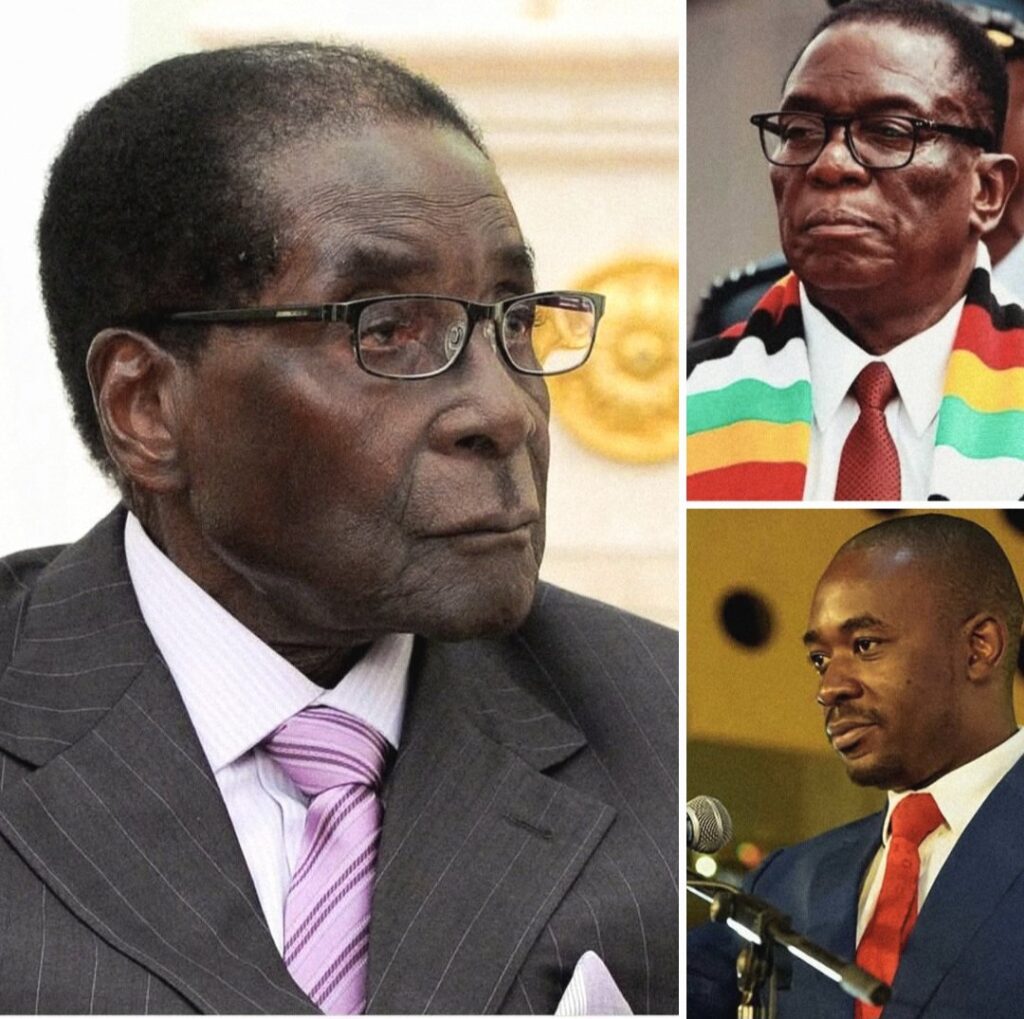
Responsible and progressive citizens should not indulge opposition leaders like Nelson Chamisa into that dangerous political culture and path to dictatorship.
We know how this has damaged some people’s collective psyche and the nation, creating an authoritarian dystopia.
Ruling Zanu PF leaders and their supporters have a strong aversion to criticism – even constructive scrutiny – when they occupy public office and manage taxpayers’ funds which pay for their government programmes, salaries, allowances, trips, personal upkeep and comfort.
Criticising Mugabe was regarded as treasonous at some point.
People were badly hounded, punished and isolated for that.
Some suffered serious backlash, including intimidation, physical harm and even death.
Mnangagwa, Mugabe’s protege, has continued with personality cult politics and the autocratic mindset of his mentor’s era, hence repression and violence are his stock-in-trade.
Tragically, that intolerance has spread to the opposition where criticising their leaders like Chamisa is regarded as selling out.
Friedrich Nietzsche warned us: “If you gaze long into an abyss, the abyss also gazes into you.”
The quote is often precedes the aphorism: “He who fights with monsters should see to it that he does not become a monster himself.”
This is from Nietzsche’s Beyond Good and Evil, 1886. In a democratic society, which Zimbabwe is at least in form rather than content, politicians are considered servants of the people, making them subject to public scrutiny, questioning, and evaluation of their performance.
𝑻𝒉𝒆 𝑬𝒎𝒑𝒆𝒓𝒐𝒓’𝒔 𝑵𝒆𝒘 𝑪𝒍𝒐𝒕𝒉𝒆𝒔: 𝑾𝒉𝒚 𝑬𝒙𝒆𝒎𝒑𝒕𝒊𝒏𝒈 𝒁𝒊𝒎𝒃𝒂𝒃𝒘𝒆𝒂𝒏 𝑷𝒐𝒍𝒊𝒕𝒊𝒄𝒊𝒂𝒏𝒔 𝒇𝒓𝒐𝒎 𝑪𝒓𝒊𝒕𝒊𝒄𝒊𝒔𝒎 𝒊𝒔 𝑼𝒏𝒅𝒆𝒎𝒐𝒄𝒓𝒂𝒕𝒊𝒄
The cornerstone of any functioning democracy is the ability of citizens to hold their elected officials or aspiring leaders accountable, a process that inherently necessitates the freedom to criticise, question, and challenge those in power.
In Zimbabwe, however, the political landscape has often been characteriaed by an atmosphere where questioning the government is viewed as an act of treason, and certain politicians are treated as immune from scrutiny.
That applied to Mugabe, now Mnangagwa and Chamisa. Although Chamisa is not in government, he still has to be held accountable because he is aspiring to occupy public office and lead the nation.
So he must be held accountable for his actions, decisions and indecisions – now.
The idea that some politicians in Zimbabwe cannot be criticised is not just absurd; it is fundamentally undemocratic, designed to suppress dissent, mask incompetence, and entrench a culture of mediocrity and authoritarianism.
To shield political leaders from criticism like ruling party and some opposition supporters do is to reject the fundamental premise of a republic, which is that power resides with the people, not the rulers.
When accountability is removed, leaders act without fear of consequence or backlash.
In Zimbabwe, this has historically manifested in severe economic decline, widespread corruption, and stifling of political opposition.
Laws such as the “Patriotic Bill” (Criminal Law Amendment Act), which criminalises actions that “harm the nation’s sovereignty” by encouraging, coordinating, or participating in meetings that criticise the government, have been used to stifle dissent and evade accountability.
This culture of enforced silence is inherently undemocratic because it violates basic constitutional rights in the first place.
It creates and nurtures dictators.
While the constitution guarantees freedom of expression and other political and civil liberties, laws and despotic practices frequently undermine this, restricting the space for civic and opposition action.
The notion that a particular politician’s actions are beyond question turns leaders into dictators and citizens into subjects. Mnangagwa and Chamisa’s supporters must remember that.
A thriving democracy requires the free marketplace of ideas, where even unpopular opinions can be expressed without backlash.
When criticism is branded as a “patriotic” violation or “selling out”, it shows that the governing party or opposition leadership relies on fear rather than merit to maintain its position.
Furthermore, the prohibition of criticism enables corruption and incompetence to flourish.
Without a free press and an informed citizenry allowed to openly discuss government and leadership failures, mediocrity and corruption remain shielded from public view.
In a democracy, criticism is not a sign of disloyalty or hate; it is a mechanism for accountability and correction. When people criticise Mnangagwa or Chamisa, it doesn’t mean they hate them.
It simple means they want them to perform better as leaders.
Freedom of expression allows for the identification of leadership, governance and policy failures, for instance which led to reducing Zimbabwe to a poor dysfunctional economy and a poverty dungeon when it was a prosperous country that is natural resource-rich.
By stifling or banning dissent, political leaders protect their own narrow interests, not those of the nation.
That is not in the public interest at all.
The argument that criticising the government makes one an enemy of the state is a classic tool of repressive regimes to maintain power.
It equates the ruling party with the state itself.
However, loving one’s country often requires criticising the policies that are destroying it.
When citizens are silenced, the government can get away with corruption and incompetence, while operating with impunity, leading to economic failure and repression of political alternatives.
For that reason, the opposition must be scrutinised.
The notion that Chamisa cannot be criticised is a dangerous fallacy that negates the very definition of democracy.
It is a tool of intimidation or fear, used to silence, control, and ensure that leadership is never held accountable for its actions.
For Zimbabwe to achieve its full potential, it must ensure public officials are answerable to the people in an environment where dissent is not criminalised, but rather seen as essential for progress.
Criticism is essential for checking abuse of power, ensuring transparency, and that government actions align with the public interest.
It encourages officials to be professional and accountable, and, done constructively, can lead to reversal of unpopular policies or harmful decisions. Robust political debate is the core of a democratic society.
Restriction of criticism is often a hallmark of tyranny, designed to stifle dissent and protect those in power from accountability.
A watchdog function, often fulfilled by the media and opposition parties, is crucial for highlighting failings and preventing government overreach.
That is why the notion that any political figure — regardless of their platform or popularity — should be immune to criticism is fundamentally at odds with the principles of a healthy democracy.
In a nation with a complex history of political struggle like Zimbabwe, the tendency to shield leaders from scrutiny is not a sign of loyalty; it is a slavish devotion and barrier to genuine democratic engagement.
Democracy thrives on a clash of ideas, debates and arguments.
When a leader is treated as beyond reproach, a cult of personality often replaces accountability and breeds dictatorship.
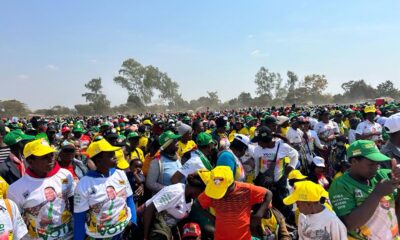
Personality cult politics is a key feature of Zimbabwean politics, from the days of Joshua Nkomo, Mugabe, Morgan Tsvangirai to Chamisa.
This has historically created significant risks for political parties, and for governance and democratic processes, manifesting in the erosion of institutional checks and balances, militarisation of the state, and internal instability within government.
At the height of his popularity, Nkomo was regarded as infallible by some.
That significantly contributed to his many political misjudgements and failures as a leader.
For instance, Nkomo completely misjudged Mugabe and Zanu PF’s politics and intentions during and after the war, which he later admitted.
With freedom of expression and criticism allowed within Zapu, certain things could have been avoided.
That applies to Mugabe and Zanu PF, as indeed to Tsvangirai. It also applies to Chamisa, Tendai Biti, Welshman Ncube and others.
Put differently, it applies to all those in leadership, be it in politics, business or religion. For opposition supporters, the desire to protect Chamisa often stems from a defensive posture against a brutally repressive Zanu PF regime.
However, if an opposition leader aims to present himself as a viable, competent and democratic alternative, he must accept and embrace the very accountability he demands from those in power.
To suggest criticising Chamisa strengthens his opponents is a fallacy; in reality, it is the lack of criticism that leaves him and his organisation brittle and unprepared for the rigours of power and governance.
Criticism is the primary mechanism through which a leader’s policies, strategies, and character are publicly tested.
Chamisa is going through that and he is not taking it well. Often, he confronts colleagues and even journalists with some dubious rumours and fictitious stories that they were criticising him instead of defending him, which is ridiculous.
There are many officials in the opposition who have been subjected to that absurdity.
This is how those in power started.
It starts with intolerance which then morphes into angry protest and backlash.
Dictators are not born, but are created by their environments and people.
This is widely supported by research in political psychology and history.
There is overwhelming evidence that authoritarian leaders arise from specific social, economic, and institutional conditions.
Rather than being biologically predetermined monsters, dictators are generally opportunists who exploit chaotic environments and a public willing to trade freedom for loyalty, security or order; worse still for accommodation or patronage.
For Zimbabwe to move past its history of authoritarianism, its political culture must evolve to view dissent as a tool for refinement rather than an act of betrayal.
If Chamisa’s strategic decisions —such as his approach to electoral issues or internal party structures — are not questioned by his base, his movement risks repeating the same top-down and unresponsive leadership patterns that have historically plagued Zimbabwean politics.
It is inherently preposterous to demand democratic reforms from the state, while maintaining an undemocratic internal culture within the opposition.
Democracy is not a destination reached by electing a saviour; it is a continuous process of checks and balances.
By insulating their leader from criticism, opposition supporters inadvertently create a situation where power can be exercised without accountability.
Democratic maturity involves acknowledging that every leader is a public servant and fallible, and every public servant must be held answerable to the people they claim to represent.
The health of Zimbabwe’s democracy depends on the ability of its citizens to critique all sides of the political aisle, not just those in power.
Elevating anyone, be it Mnangagwa or Chamisa, to a status of Papal infallibility is dangerous; it undermines the very freedom that Zimbabweans have been struggling for so long.