BY NATHAN GUMA
FOR more than a decade in which Zimbabwean serial entrepreneur Freedom Mukanga worked in meteorology, he noticed a recurring pattern putting communities at risk of natural disasters.
From drought-stricken farming communities to flood-prone regions across Southern Africa, the pattern was clear, that without reliable data to observe, track and warn, preparedness remained impossible.
“I am a trained Meteorological Technician holding a World Meteorological Organisation (WMO) Class IV qualification, and I spent 12 years working with the Zimbabwe Meteorological Services Department in various roles,” he says.
“These roles gave me a strong appreciation of weather and climate from operational, strategic, and policy perspectives. It was through this experience that I came to fully understand the scale of the challenges Africa faces in preparedness and response to weather- and water-related disasters.”
Since then, Mukanga has made a strategic shift, founding a data-driven model that uses partnerships with U.S. technology firms to strengthen early warning capacity, climate resilience and disaster preparedness in vulnerable communities.
This month, he also won the Young African Leaders Impact Award, presented by the U.S. Department of State’s Bureau of Educational and Cultural Affairs, for his work supporting Zimbabwean communities.
Through his company FreedPer Scientific, which is expanding local weather stations and hydrometeorological data networks across Zimbabwe, he has forged collaborations with U.S. corporations to make disaster prevention more effective.
Several of these networks were established through the fellowship, which connects young African leaders to professionals in the U.S., enabling strategic partnerships.
His company is on track to impact 1.4 million people by 2030.
Zimbabwe is among several African countries hard hit by floods and other natural disasters over past decades, resulting in the loss of livelihoods and farmland in rural communities.
For instance, data by Srringer Nature shows that when Cyclone Idai hit Zimbabwe in 2019, land loss was the most severe impact (63.1%), with grain and field/tree losses also exceeding 58% each.
Equipment and business assets were also affected, leading to loss of livelihoods, raising the need for sound disaster preparedness.
To mitigate these effects, FreedPer has partnered with corporations such as Synoptic Data, the world’s largest global repository of weather and environmental data, among other U.S. firms.
“Through my personal relationship with Synoptic Data’s President, Ashish Raval, we are working together to expand more aggressively across Africa,” he says.
“What makes Synoptic unique is its ability to bring together observations from many different sources into a single, quality-controlled platform that can be accessed in real time or historically for decision-making across sectors.”
For Zimbabwean communities, this means access to reliable, localised, real-time and historical weather data for planning, early warning and risk reduction.
Through Synoptic’s API and data tools, communities, researchers and institutions can make informed decisions based on evidence rather than estimates.
Besides Synoptic data, Mukanga is also in the process of bringing BlueIQ to Zimbabwe’s hydrometeorology sector.
Infrastructural gap
Mukanga says the major challenge affecting disaster prevention has been a significant gap in hydrometeorological infrastructure.
This refers to systems, tools and institutions used to observe, measure, analyse and share weather and water information, allowing societies to anticipate and manage climate-related risks.
“If we do not have the systems to observe, track, measure, and issue warnings, we remain permanently exposed,” he says.
“You cannot insure what you cannot measure, and you cannot manage what you cannot track. Globally, Africa accounts for nearly 30% of weather and climate data gaps, which continues to compound the continent’s climate risks.”
“That reality is what pushed me to start FreedPer Scientific.”
How partnerships are helping local communities
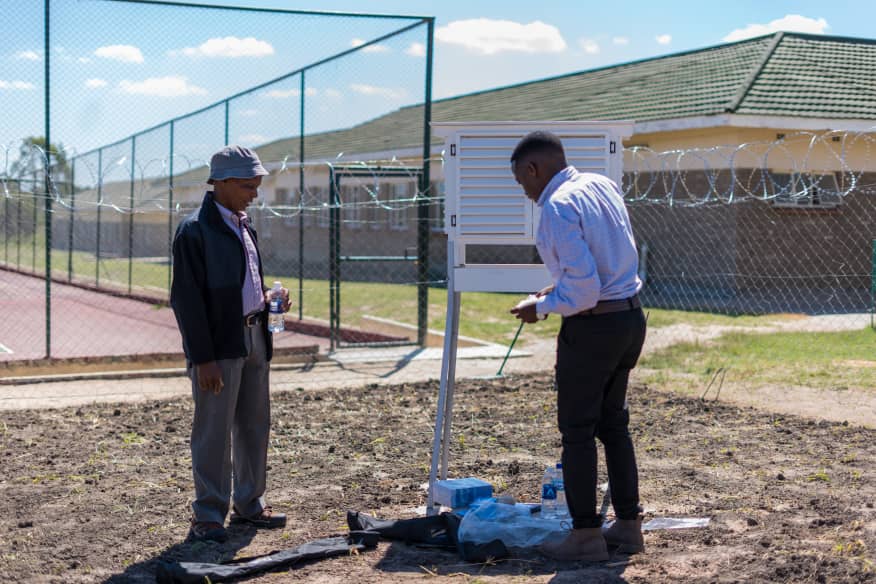
Through FreedPer, Mukanga supplies weather stations across multiple sectors, including education, mining, exploration, hydrology and the development sector.
“One of our key focus areas is schools. We have found that weather stations offer multi-layered benefits in educational settings, as they support science learning, promote citizen science, and serve as permanent observation points,” he says.
“Because schools are fixed institutions within communities, a weather station installed at a school can benefit surrounding communities for generations.
“Our model is supported by strong global partnerships. We work with hydrometeorological equipment manufacturers around the world, sourcing high-quality instruments that can operate reliably in local conditions.”
In the U.S., Mukanga recently secured a partnership with AEM and has begun reselling their Davis Instruments products in Zimbabwe, with plans to roll out Earth Networks solutions, particularly for lightning detection and observation.
At community level, he says access to localised weather data has helped schools and nearby farmers make more informed decisions about planting times, rainfall expectations and measurement.
In several cases, schools hosting stations have become informal information hubs, sharing real-time weather updates with surrounding communities, helping reduce losses and improve preparedness.
From his experience in Zimbabwe, Mukanga says data should be integrated into decision-making structures, not treated as a standalone product.
“Early warnings must feed directly into civil protection mechanisms, agricultural advisory services, and development planning,” he says.
“As we scale across Sub-Saharan Africa, the goal is not to replicate a single model, but to apply these principles, strong observations, community ownership, smart partnerships, and institutional integration, to build early warning systems that are locally relevant and regionally scalable.”
First published by IOW Data