BY NATHAN GUMA
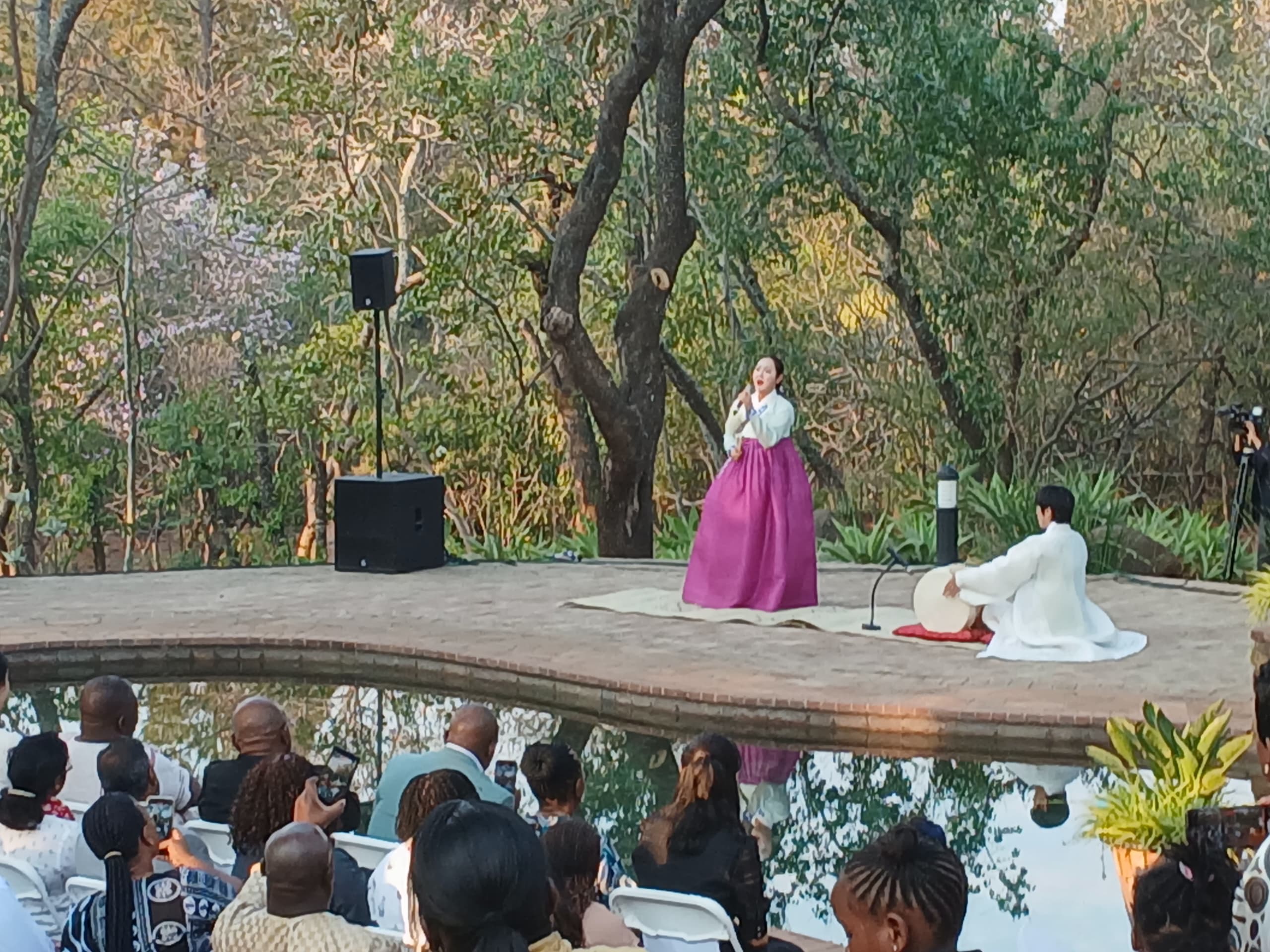
It is dusk at the South Korean Ambassador’s residence in Highlands, Harare, and crowds are trickling in to be part of the Sounds and Spirit of Korea, a showcase of the country’s art and traditions.
Visitors pass by a few desks, grabbing refreshments and South Korean souvenirs such as the buchae, which translates to ‘hand fan’ or ‘a tool that creates wind’ in English.
This is the second and final day of the K-Festival, which celebrates South Korean culture, with the first having been held in Bulawayo, Zimbabwe’s second-largest city.
The K-Festival is evolving into a cultural bridge, deepening collaboration between Zimbabwe and South Korea through exchanges, performances, and people-to-people connections, reinforcing stronger bilateral ties beyond economics into shared cultural appreciation.
Some of the cultural shows range from the intriguing Pansori to the captivating Pungmul Nori.
Pansori is a traditional South Korean art form that combines music, storytelling, and drama, where a solo singer, known as a ‘sorikkun’, narrates epic tales through speech and expressive gestures, accompanied by a drummer who provides rhythmic support.
Pungmul Nori is a traditional Korean folk performance combining drumming, dancing, and singing, rooted in farming communities to celebrate good harvests, ensure favourable weather, and strengthen community bonds.
It involves intricate music, often featuring four primary percussion instruments, elaborate costumes, and dances such as the spinning streamer hat dance.
During the hat dance segment, as the drums beat, dancers with ribboned hats move their heads sharply, forming circling, snaking ribbon patterns in the air.
Instruments played during this Pungmul Nori include the Kkwaenggwari, a small gong symbolising thunder; the Jing, representing wind; the Janggu, representing rain; and the Buk, symbolising clouds.
The dance is significant for fostering community unity, celebrating agricultural traditions, expressing spiritual beliefs, and serving as a cultural foundation for Korean folk arts.
In an interview, Ambassador Park Jae Kyung said that his country is making renewed efforts to develop bilateral relations economically, culturally, and in several other areas.
“We are already doing exchanges, yes, and collaboration as well,” he said. “Hope Masike, the Mbira player, was in Korea last year at the invitation of the Korean government, and a Korean cultural team also returned the visit to Zimbabwe, including for this festival.
“We had a wonderful one in Bulawayo as well. Yesterday, the citizens there all enjoyed it greatly. We will continue to promote this type of cultural exchange.
“We place Zimbabwe as a priority. You have a wonderful country and wonderful people. We are renewing our efforts to develop bilateral relations economically, through people-to-people exchanges, and in all other areas.”
Last year, there were two main events in Harare related to the K-Festival: firstly, the K-Pop Festival 2024, and secondly, the larger Korea Festival 2024 held at the Celebration Centre.
In September last year, the Korea Festival celebrated over 30 years of diplomatic relations between Zimbabwe and South Korea and featured the Korea National Taekwondo Demonstration Team, K-food, and K-beauty products.
This year, the main festival held in Bulawayo featured energetic performances by the Jeonbuk State Team, including traditional dance, K-pop, and Taekwondo, alongside hands-on experiences such as hanji crafts and Korean calligraphy.
Attendees also had the opportunity to explore K-cosmetics, K-companies, and participate in Korean cultural experiences and a ‘K-Games Challenge’.